
Hot Spots in Dogs: Causes, Treatment, Prevention, and When to See a Vet

Some hot spots can double in size within 24 hours. That speed is the first clue that you’re not looking at a slow-brewing skin mystery—you’re seeing a self-perpetuating itch–trauma cycle in action, where a small irritation turns into a raw, wet patch because your dog can’t stop licking, chewing, or scratching it. The biology is dramatic, but the mechanism is surprisingly ordinary: something hurts or itches → the dog traumatizes the skin trying to fix it → the skin becomes more inflamed and contaminated → it itches/hurts even more.
In veterinary terms, a “hot spot” is acute moist dermatitis (AMD). You may also hear pyotraumatic dermatitis, which is a useful phrase because it reminds everyone—gently but firmly—that the lesion is self-inflicted trauma with secondary bacterial overgrowth, not usually a mysterious infection that “just appeared.”

This matters for your sanity as a caretaker, because it reframes the problem from “Why is my dog’s skin suddenly failing?” to the more solvable question: What started the licking?
What a hot spot actually is (and why it looks worse than it started)
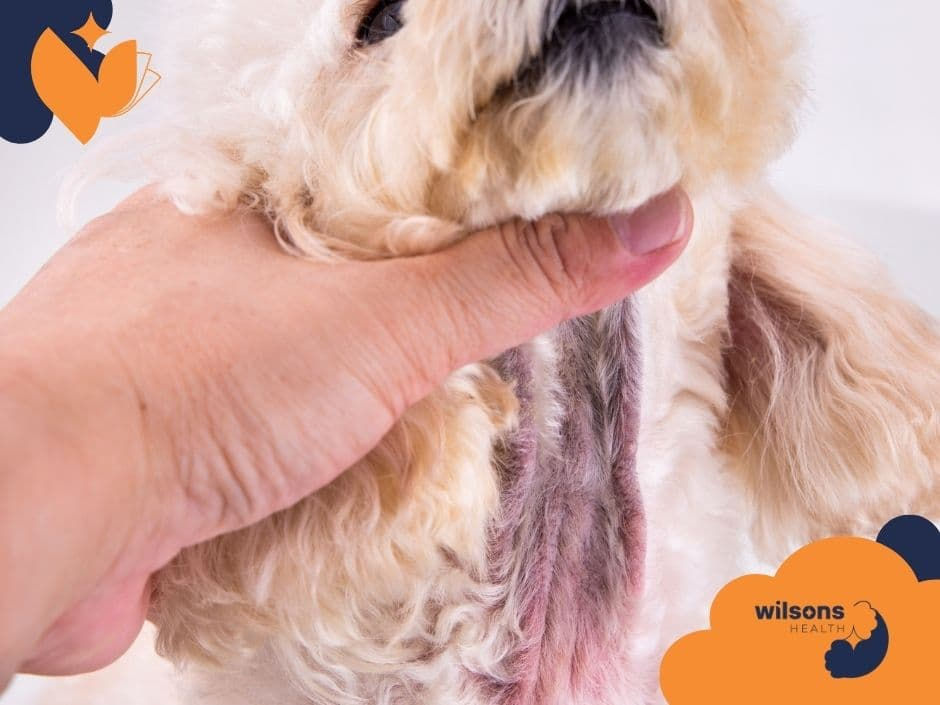
A hot spot is typically:
Red
Moist/oozing or sticky
Warm
Painful and/or intensely itchy
Often smelly
Often surrounded by matted fur
Early on, it may look like a small, irritated patch—easy to miss under thick fur. As it becomes established, it can look sharply demarcated, hairless, crusted or scabbed, and still wet around the edges.
A common caretaker report is not “I saw a rash,” but “My dog suddenly became obsessed with one spot.” Dogs may act restless, guarded, or irritable because these lesions can be genuinely painful—not just cosmetically ugly.
Typical locations
Hot spots tend to show up where moisture, friction, or easy access meets a strong itch impulse:
Neck and base of the ears
Face
Rump and tail base
Trunk
Thigh
Heavier-coated areas are frequent offenders, partly because dampness and debris can hide and linger.
The most important mental model: not “a skin infection,” but an itch–trauma loop
Many hot spots have surface bacterial overgrowth, often involving Staphylococcus pseudintermedius. But in most cases, bacteria are not the first domino. The first domino is usually itch or pain—and the dog’s normal, determined attempt to relieve it.
Think of a hot spot as a feedback loop:
Trigger (itch/pain) starts licking/scratching
Skin gets damaged (“self-trauma”)
Moisture + inflammation + broken skin allow bacterial overgrowth
The area becomes more inflamed, wetter, itchier, more painful
Dog intensifies licking/scratching
Lesion expands quickly (sometimes shockingly so)
This is why it can look like the hot spot “came out of nowhere.” It didn’t. It accelerated.
What usually triggers hot spots (the detective work that prevents the next one)
A hot spot is often the end stage of something else. If you only treat the patch, you may get temporary relief—but the underlying itch generator stays online.
Here are the major triggers repeatedly emphasized across clinical references:
1) Flea-bite hypersensitivity (a top culprit)
Even a small exposure can matter in allergic dogs. The classic “hot spot at the tail base” story often has a flea chapter in it—even when you aren’t seeing fleas.
When this is part of the picture, it helps to understand the logic of flea allergy dermatitis: the reaction is to flea saliva, so the skin can erupt from minimal bites.
2) Other ectoparasites
Mites/scabies and other parasites can create intense itching that fuels self-trauma.
3) Ear disease (otitis externa)
An itchy or painful ear can lead to scratching at the head/neck, creating hot spots near the ears or on the side of the neck. Sometimes the hot spot is what you notice first, but the ear problem was running the show.
4) Allergic dermatitis (environmental or food-related)
Atopy (environmental allergies) and food allergy can keep the skin in a chronically reactive state. In dogs with frequent flare-ups, a targeted conversation about dog allergy testing can be a turning point—not because it’s magic, but because it changes the plan from whack-a-mole to pattern recognition.
5) Foreign material or irritants trapped in the coat
Foxtails, burrs, sticky plant material, grooming products, or anything that sits against the skin can trigger focused licking.
6) Anal sac disease / anal sacculitis
If your dog is licking near the rear end, scooting, or suddenly fixated on the rump/tail base area, anal sac discomfort can be the “itch” that doesn’t look like itch.
7) Coat factors: mats, moisture, and poor airflow
Dense coats and matting trap humidity and debris against the skin. This is one reason long- or thick-coated dogs show up so often in hot spot discussions.
8) Warm, humid weather
Hot spots are repeatedly associated with humid seasons—likely because moisture plus friction plus reactive skin is an efficient recipe for trouble.
Breed patterns
Certain breeds are often mentioned as overrepresented, including:
Golden Retrievers
German Shepherd Dogs
Newfoundlands
Collies
Saint Bernards
This isn’t destiny; it’s risk—often related to coat, skin biology, and allergy prevalence.
Why recurrent hot spots deserve more respect than a “skin thing”
Veterinary guidance is consistent on one point: recurrent hot spots warrant investigation for an underlying condition. Not because your dog is fragile, and not because you failed the first time—but because recurrence usually means the trigger (allergy, parasite exposure, ear disease, anal sac disease, coat moisture problems) is still present.
A useful way to bring this to your veterinarian is to shift from “Can we treat this hot spot?” to:
“What do you think is driving the itch or pain that starts these?”
“Do you see patterns in location (ears, tail base, thigh) that point to fleas/ears/allergies/anal sacs?”
“If this keeps happening, what workup would be most efficient?”
That change in framing is often where longer-term relief begins.
What treatment typically focuses on (without pretending there’s one simple fix)
Most treatment plans revolve around two urgent priorities:
1) Interrupt the self-trauma
Stopping licking/chewing/scratching is not optional because it’s the engine of expansion. Many clinicians recommend an Elizabethan collar (cone) or similar barrier early.
This can be emotionally hard. Dogs may look offended. You may feel like a villain. But biologically, it’s very straightforward: skin can’t re-epithelialize while being sandpapered by teeth and tongue.
2) Make the skin breathable and cleanable
Veterinary sources consistently describe:
Clipping/shaving the hair around the lesion so air reaches the skin and discharge can be removed
Cleansing with an antiseptic (chlorhexidine is frequently mentioned in guidance) or veterinarian-recommended products
Anti-inflammatory therapy to reduce itch and pain and break the cycle
Antibiotics when bacterial complication is present or strongly suspected (particularly if the lesion is severe, spreading, or involves folliculitis)
It’s worth naming an important nuance: hot spots often look “infected,” and there may indeed be bacterial overgrowth—but treatment is still aimed at both the bacteria and the itch–trauma loop. If you solve only one, you often don’t solve the case.
For context, hot spots can overlap with broader bacterial skin infections, but hot spots have that distinctive “sudden, localized, self-traumatized” personality.
What about topical products and shampoos?
Topicals can be helpful support—especially for cleansing and reducing surface microbes—but they’re not a substitute for breaking the licking cycle or addressing the trigger. The most useful way to think about itchy-dog shampoos and topicals is as part of the environment you create for healing: cleaner skin, less microbial load, less itch—while the root cause is being handled.
Allergy medications (when allergies are the driver)
If allergies are suspected or known, clinicians may discuss anti-itch/allergy medications as part of longer-term control. The goal isn’t to “mask” symptoms; it’s to prevent the itch intensity that starts the trauma loop in the first place. The landscape is varied (and individualized), which is why a clear overview of dog allergy medications can help owners participate in decisions without feeling lost.
Healing: what “better” looks like (and what can be misleading)
Hot spots often have a good prognosis when treated promptly and when the trigger is identified.
Signs you’re moving in the right direction typically include:
Less redness and heat
Less moisture/oozing
The lesion stops expanding and begins shrinking
The dog is less compelled to lick/scratch
Scabbing and gradual re-epithelialization (new skin forming)
The misleading part: a hot spot can look improved while the underlying itch source remains active. That’s when owners experience the most demoralizing version of this condition: the patch heals, everyone exhales, and then… a new one arrives, or the same one reactivates.
If that happens, it’s not proof you did anything wrong. It’s usually proof that the body is still receiving an itch signal—fleas, allergy flare, ear discomfort, anal sac pain, parasite exposure, coat moisture—and the dog is responding like a dog.
Severe lesions can become more complicated if self-trauma continues, potentially involving deeper bacterial involvement or wider inflammation. That’s one reason clinic evaluation is so strongly emphasized in many references, even when some sources acknowledge that very mild lesions may improve with prompt care.
The “why is my dog acting like this?” section you deserved earlier
Hot spots can cause:
Sleep disruption
Restlessness
Guarding the area
Snapping when touched (pain, not “bad behavior”)
Sudden irritability
This is one of those situations where behavior is a symptom. When you see fixation on one spot, you’re not witnessing stubbornness—you’re watching an animal respond to a sensation intense enough to override normal priorities.
For many owners, the emotional arc is predictable: guilt for not noticing sooner, anxiety because it worsened fast, and frustration when it returns. The most stabilizing reframe is this:
A hot spot is often less about “skin hygiene” and more about biology + opportunity—itch plus access plus a coat that holds moisture. You didn’t “allow” a hot spot. You encountered a system that can spiral quickly once it starts.
Prevention that’s actually prevention (not just “keep an eye on it”)
Prevention is fundamentally about reducing the triggers that start licking/scratching.
In everyday terms, that tends to mean:
Reliable parasite control, especially if your dog has any pattern consistent with flea allergy
Managing chronic allergy tendencies (seasonal itch, recurrent ear issues, paw licking, facial rubbing)
Addressing ear discomfort early, before it becomes a neck/cheek hot spot
Not ignoring rear-end discomfort patterns that could point to anal sac issues
Coat maintenance that reduces matting and trapped moisture—particularly in warm, humid seasons and in dense-coated dogs
Responding early to “my dog keeps going after that one spot” before the skin breaks down
If hot spots are recurring, it’s reasonable to talk with your veterinarian about whether the next step is more of an allergy-focused plan (sometimes including testing), parasite strategy adjustments, or a deeper skin/ear evaluation—because recurrence is often a sign, not bad luck.
What we know well—and what we still don’t
It can be grounding to know where the evidence is strong and where medicine is still more art-plus-consensus than neat data.
Well established:
Hot spots are acute, self-inflicted lesions driven by itch and/or pain
Common triggers include flea allergy, other parasites, allergies, ear disease, anal sac disease, and coat moisture/matting
Lesions can worsen very quickly
Core management involves stopping self-trauma, clipping, cleansing, reducing inflammation/itch, and addressing the underlying trigger
Recurrent cases deserve investigation beyond the lesion
Still under-studied (in the sources available):
True population prevalence and incidence by region/season
Recurrence rates by breed or climate
Best standardized home-care protocol for very mild cases
Comparative effectiveness of specific antiseptics/anti-inflammatories/barrier methods
Quantified quality-of-life impact on dogs and caregivers
This uncertainty doesn’t mean the condition is mysterious; it just means your veterinarian’s recommendations are often built on consistent clinical experience and reference guidance, not dozens of head-to-head trials.
A hot spot is one of the clearest examples of how a dog’s body can look like it’s “suddenly falling apart,” when what’s really happening is a fast loop: sensation, coping behavior, skin damage, amplified sensation. When you treat it as a loop—interrupt it early, then go looking for what started it—you’re not just healing a patch of skin. You’re giving your dog’s nervous system fewer reasons to panic, and giving yourself a plan that holds up the next time life gets humid, itchy, or a little too quiet for comfort.
References
Clinicians Brief — Guide to Managing Hot Spots on Dogs
PDSA — Hot spots (acute moist dermatitis) in dogs
Auburn Animal Hospital — Acute Moist Dermatitis In Dogs
PetMD — Hot Spots on Dogs: Causes, Treatment, and Home Remedies
MedVet — Hot Spots in Dogs: What They Are and How to Treat Them
Vetlexicon — Skin: acute moist dermatitis in Dogs
Cornell University Riney Canine Health Center — Hot spots
Vet Times — Dermatology hot spots in dogs – treatment and advice for owners
Veterinary Partner — Hot Spots (Pyotraumatic Dermatitis) in Dogs and Cats


Comments